DG News: August 2026
By Discourse Graphs Team | 2026-09-03
- newsletter
Hi again everybody, and welcome to the August issue of the Discourse Graph newsletter. August is more than out-of-office email auto-responders and preseason football in the discourse graph universe — it’s when we lock in and tackle some of our biggest projects.
New in the Obsidian discourse graph plugin: advanced node search
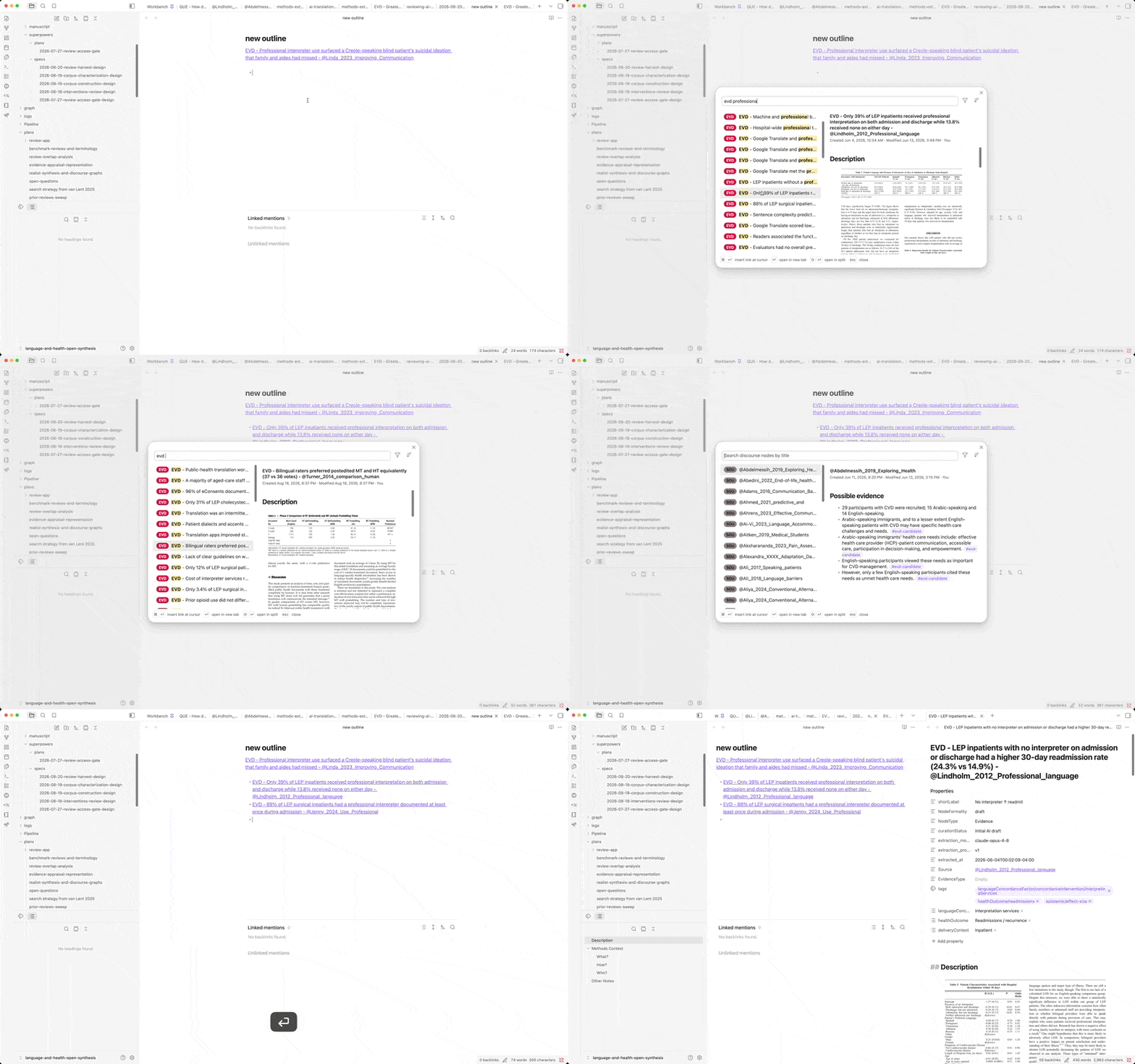
We’ve shipped a dedicated search interface for discourse nodes to support growing discourse graphs: node search surfaces discourse nodes only, with advanced filtering features.
Our community is growing!
Our Slack just reached 100 members! Join us for quick updates, tips, and troubleshooting.
Ask the docs: mapping claims and evidence
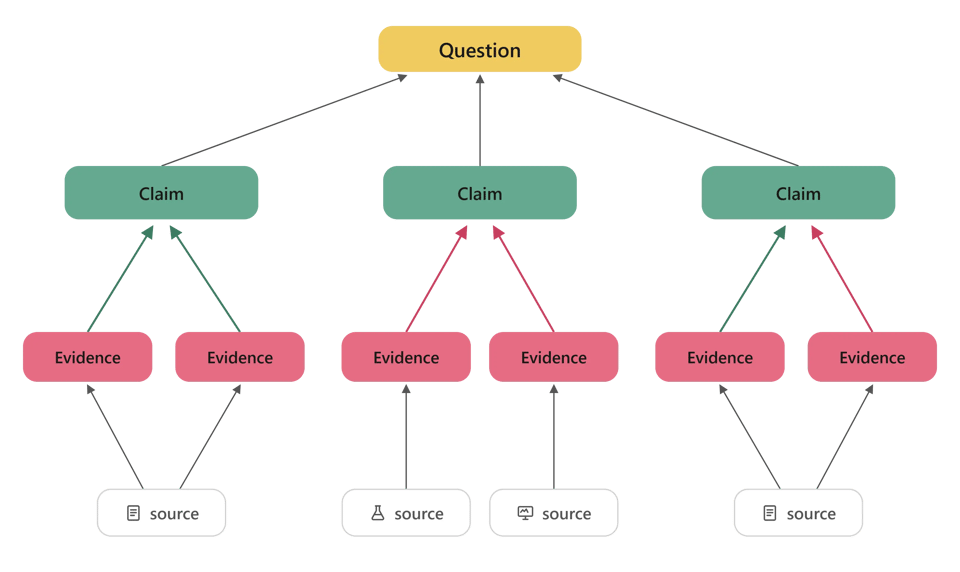
Learn how to use discourse relations to synthesize across different sources in this short explainer, live from our website documentation.
Dispatches from the frontier: a series on how discourse graphs are improving scientific research
We’ve deployed discourse graph tools in labs across cell biology, biophysics, and human-computer interaction — 6+ labs including the OASIS Lab at the University of Maryland, the MATSUlab at the University of Washington, the Holehouse Lab at Washington University School of Medicine, and the Allen Institute for Cell Science — as well as to individual researchers around the world. Our question: how can discourse graphs be used to accelerate research?
In our July issue we shared how discourse graphs can enhance experiment planning and interpretation. This month, we’ll look at how discourse graphs can be used for iterative synthesis of research results.
Better in-progress synthesis
Claim: Papers demand linear arguments. But science-in-progress is a mess of partial results, competing hypotheses, and tentative claims. Discourse graphs let researchers synthesize without rushing to linearization.
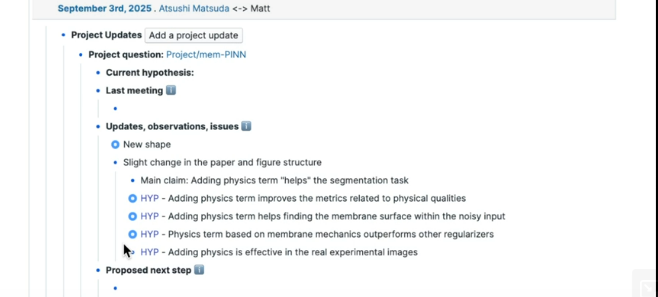
Evidence: A cell biology postdoc at the University of Washington used hypothesis candidates to strengthen the argument structure of his manuscript outline.
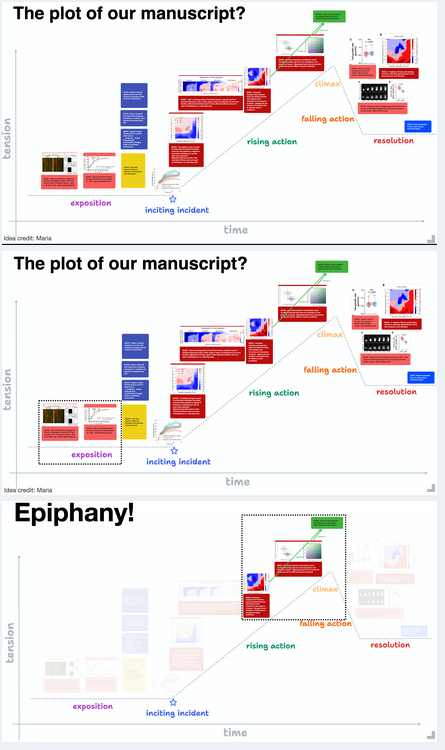
Evidence: A lab PI rapidly constructed an initial synthesis of conclusions for a talk by assembling discourse nodes created across multiple lab members’ notes — the lab graph accelerated a breadth-first search across their recent work. Other lab members used the shared discourse nodes to organize their research into a comprehensive narrative using classic story structure tools.
Evidence: A PhD student at the Stowers Institute for Medical Research used her graph to tabulate important results and conclusions that weren’t immediately relevant to her manuscript-in-progress but were useful for ongoing work.
Evidence: A biophysics researcher used his discourse graph to “remain in the cloud” to synthesize next steps while pondering a set of confusing and sometimes contradictory results from his ongoing experiments.
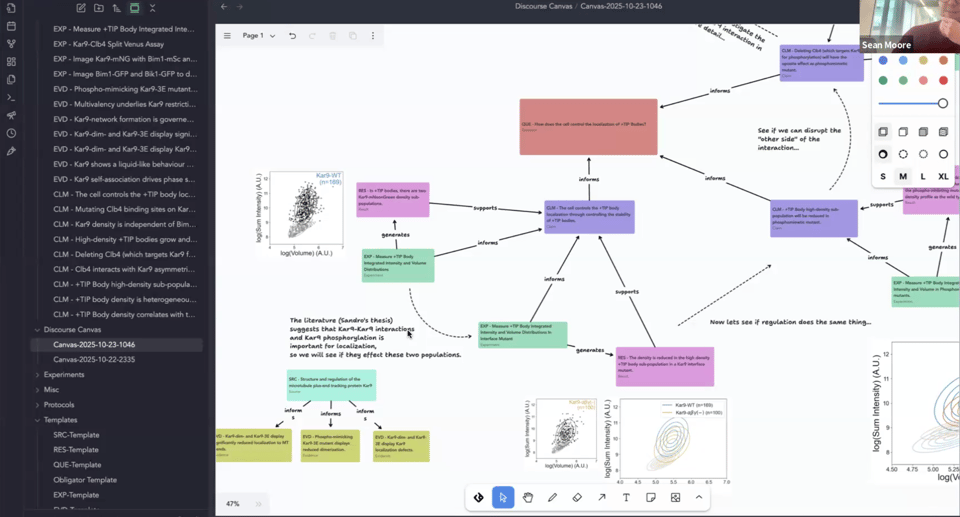
Claim: Discourse graphs help you capture what matters before you know what the final story is.
Tune in next month when we explore how our pilot users are using discourse graphs to bring newcomers to a lab up to speed on cutting-edge research!
We’d love to hear from you about how you’ve been using discourse graphs to accelerate your research. Please contact us via email to share your experiences!
Contributions
- If you’re interested in contributing to the project, please read our guide on GitHub for how to do so.
- We are also open to sponsors, collaborators, and grant opportunities. Please contact us via email regarding any of those.
Thanks for reading and joining us on this journey to make science and research easier and more accessible for everyone. Until next time!